

Hearing aid for people with no hearing loss!!? Why?
- Koorosh Nejad

- Dec 4, 2025
- 6 min read
Updated: Dec 5, 2025
There has been an ongoing debate on whether using hearing aids could help people with no hearing loss, particularly in hearing speech in a noisy environment. A recent update to the NAL-NL prescription by the National Acoustics Laboratory (NAL) clarified this.

Related articles:
Why do people with no hearing loss on their audiogram may have problems with speech understanding in a noisy environment?
Let me explain this. The hearing is a two-step process. We hear with our ears, what we call peripheral auditory. The sound is coded into electrical signals and sent to the auditory cortex in our brain for understanding. If you do a hearing test and your audiogram shows sound thresholds below 25 dB across the board (see below for a sample), that means your ears do a nice job in converting the sound to the electrical signals, and they are received by your brain loud enough. But this does not mean that your auditory cortex is able to process and make a good understanding of the speech in a noisy environment.
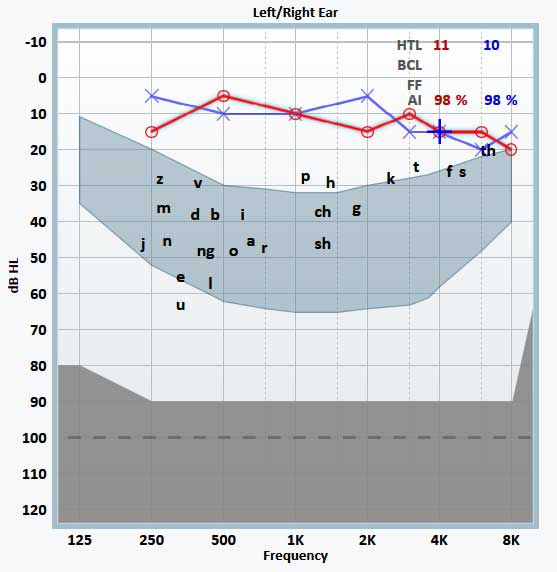
Figure 1 - An audiogram with threshold readings below dB, i.e. no hearing loss
How does the brain lose its ability to process speech in a noisy environment?
Your auditory cortex could experience a decline in processing speech. This can be due to a mix of several factors, including degradation due to ageing, impact of other health problems, listening to very loud sound, e.g. being in a profession exposed to loud sound (construction, for example), or a head trauma. The result is that our brain loses its ability to process sound. One may feel that they need people to speak more slowly for him/her to understand, or that understanding the conversation in a noisy environment becomes harder and harder. Simply said, your brain's ability to tune in to a specific sound to focus and follow the conversation is not as sharp as before.
Do hearing aids help people with no hearing loss with speech understanding in noisy environments?
Yes. When programmed correctly, the hearing aids can improve speech understanding in a noisy environment for people, even without any hearing loss. Through a combination of directional microphones, artificial-intellegence and deep neural network processing, the hearing aids can bring out the speech cues out of the context and reduce the level of background noise. This helps people with or without a hearing loss to understand speech better in a noisy background. Such a use of hearing aids will be situational, and the user does not need to wear hearing aids all the time.
Who is National Acoustics Laboratories?
The National Acoustics Laboratories (NAL) is an Australian research centre with decades of research and study in hearing loss, acoustics and how hearing aids could be set up to sound optimally for the user. NAL is famous for the introduction of prescription formulas for hearing aids, which have evolved since 1967. NAL-NL1 and then NAL-NL2 (since 2011), which is being used in audiology clinics worldwide. If you use a pair of NHS hearing aids in the UK, your hearing aids likely use the NAL-NL2 prescription to translate your audiogram into the gain levels that the hearing aid uses to amplify the sound for you.
Who uses NAL's prescription formula for hearing aids?
All the hearing aid and hearing care manufacturing companies use NAL's prescription formulas in the design of their hearing care devices and software. Audiologists all over the world use NAL's hearing aid prescription formulas when fitting or reprogramming a hearing aid for patients.
If the NAL-NL2 prescription formula has been adequate, why did NAL release the NAL-NL3 prescription formula?
According to Dr Justin Zakis, NAL's principal engineer, the following reasons encouraged NAL to release NAL-NL3 in late 2025:
Availability of more data and AI tools provided a more accurate prescription formula to the extent that NAL-NL2 needed an upgraded version (which is NAL-NL3)
NAL-NL2 was suboptimal for hearing in noise
NAL-NL2 could not support patients with a normal audiogram, but problems with speech in noise
NAL-NL2 was suboptimal for reverse sloping hearing loss; also, it was not optimal for 8 kHz and higher frequencies that some hearing aids can support
NAL-NL2 overamplified the high-pitch gains for sloping hearing loss
NAL-NL2 didnt was not optimised for listening to music

Figure 2 - Patience preferred NAL3 Comfort in Noise (CIN) module (in yellow) compared to NAL-NL3 default setting (in black).
As you can see in Figure 2, the NAL-NL3 module for comfort-in-noise has received a much higher acceptance compared to the standard NAL-NL3 prescription.
Does NAL-NL3 have a module for people with no hearing loss but a problem in hearing in noisy environments?
Yes. The Minimal Hearing Loss module of NAL-NL3 (MHL) is designed for patients with no or slight hearing loss, but who have problems with speech understanding in noisy environments. The MHLM module will increase the signal-to-noise ratio (SNR) for the speech in noisy places, and the hearing aids will be fitted with closed domes. It is recommended that such patients use hearing aids for conversation in noisy environments.
Are NHS hearing aids good for hearing speech in noise?
The free hearing aids provided by the NHS in the UK are mostly suitable for hearing in quiet environments. This is because:
The NHS hearing aids are at a much lower technology level than the premium models. Therefore, they might perform well in a conversation in quiet, but may not offer much sound processing for a conversation in noise.
The NHS hearing aids are programmed with the NAL-NL2 prescription formula, which is a prescription designed for hearing speech in quiet environments.
How can I improve my NHS hearing aids for better hearing in speech?
Besie the recommendations that I discussed in this article, you can improve the hearing experience in a noisy environment through your NHS hearing aids by upgrading their prescription to NAl-NL3. Almost all of the NHS hearing aids provided in the UK are set with NAL-NL2, which is a prescription suitable for hearing speech in quiet. Only in late 2025 will the NAL release NAL-NL3, which has a specific module for hearing-in-noise. This upgrade from NAL-NL2 to NAL-NL3 prescription needs to be done by an audiologist. Note: Please note that the NAL-NL3 is released in late 2025, and there may be a few months' delay before it is widely implemented in the hearing aid fitting software, as well as in NHS clinics.
Will my NHS hearing aid work well for speech in noise for a mild hearing loss after an upgrade to NAL-NL3?
Yes and No. Your listening experience with NHS hearing aids must improve if you upgrade the prescription from NAL-NL2 to NAL-NL3; however, the NHS hearing aids lack advanced sound and noise processing, hence the improvement will be rather limited.
As per the research study, the Minimal Hearing Loss (MHL) module improved the word recognition from 50 to a range of 51 to 59, depending on different hearing aid models. That indicates that the MHL module can help with speech intelligibility in noise, but this is also quite independent of the model of the hearing aid.

Figure 3 - Benefit to word recognition of MHL module versus NAL-NL3
As per the research study (see Fig.3), the Minimal Hearing Loss (MHL) module improved the word recognition from 50 to a range of 51 to 59, depending on different hearing aid models. That indicates that the MHL module can help with speech intelligibility in noise, but this is also quite independent of the model of the hearing aid.
Nevertheless, the real patients' experience was undoubtedly positive when compared to the same hearing aids prescribed with the MHL module versus the NAL-NL3 prescription (please see Figure 4).
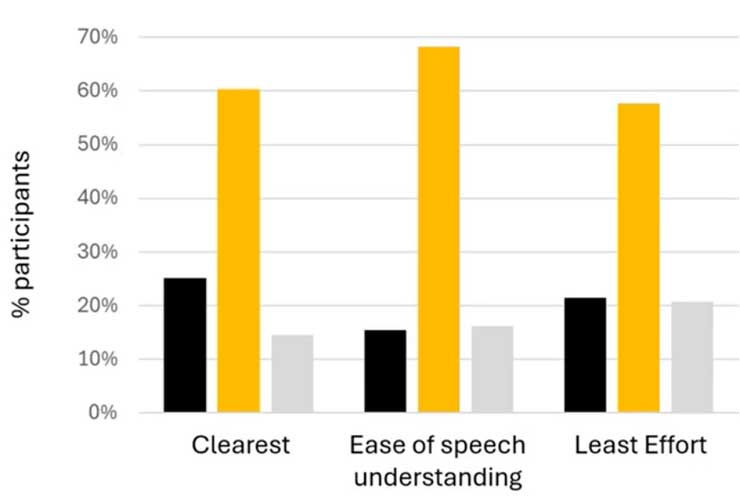
Figure 4 - Patients' real experience with MHL module (yellow) versus the base NAL-NL3 prescription (black)
Conclusion
I am glad to indicate that the introduction of NAL-NL3 is all good news for two groups of people: a. free NHS hearing aid users, and b. patients with no hearing loss but who have a problem with speech intelligibility in noisy environments.
References
Incerti, Paola, Brent Edwards, and Pádraig Kitterick. "NAL-NL3 Fitting System Technical Series (Part 1)." The Hearing Journal 78.10 (2025): 1-3.
Jermy Pang, BHSc, and AAudA MClinAud. "Why Do HCPs Need NAL-NL3?"
BENNETT, BEC, PADRAIG KITTERICK, and BRENT EDWARDS. "Understanding the NAL-NL3 Prescription System: a new era of personalised hearing aid fitting."
Questions
Please get in touch if you have any questions about NAL-NL3 or how hearing aids can help with speech intelligibility for people with no hearing loss.


Comments